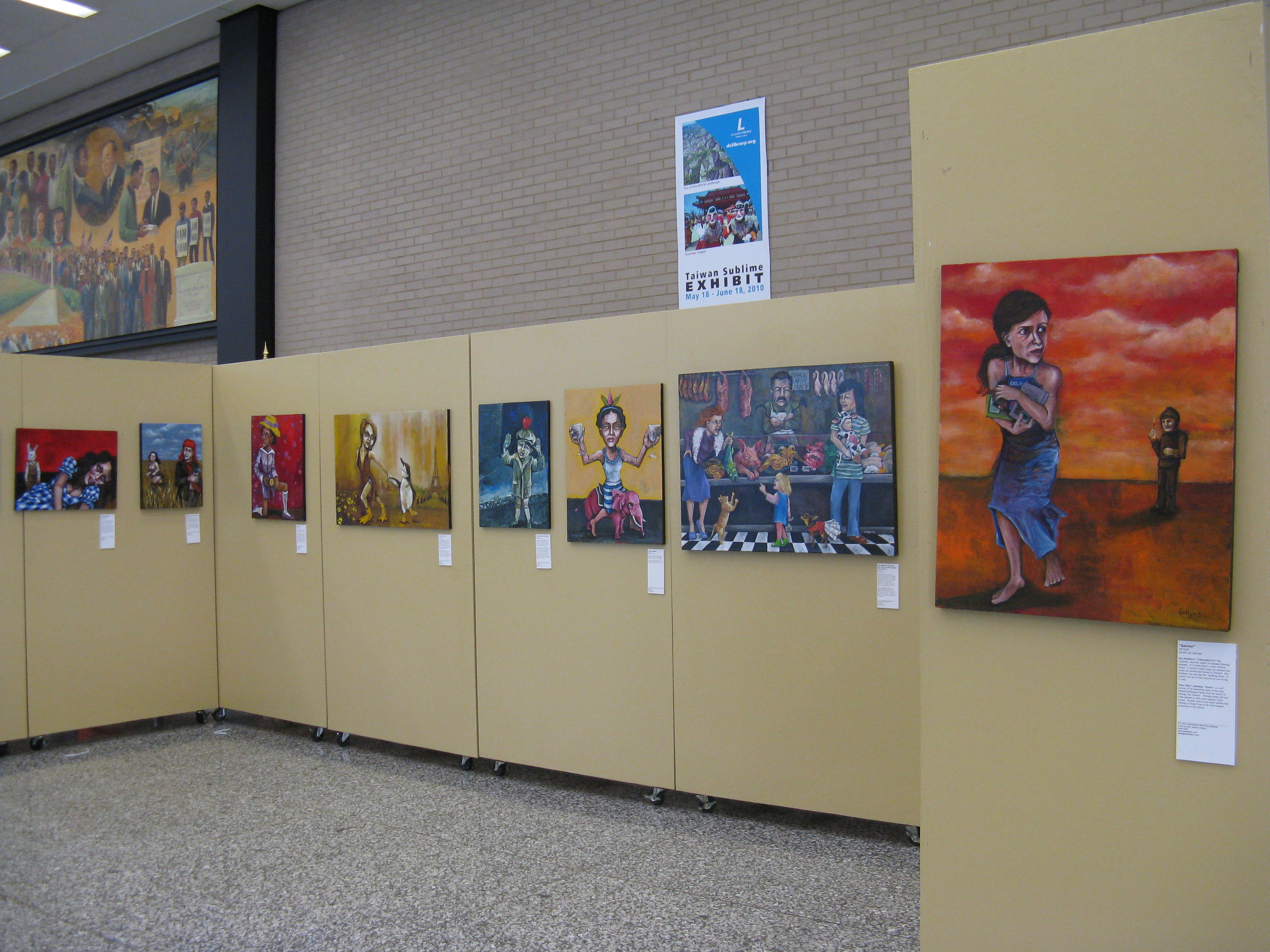
Savior · 20" × 24" · acrylic on canvas · inspired by Fahrenheit 451
MLK Library · Washington, DC · June 22 – July 31, 2010
BANNED
A solo exhibit of paintings by Dana Ellyn, each one inspired by a book someone tried to ban.
Washington, DC artist Dana Ellyn presented a solo exhibition of her recent paintings, “Banned”, at the Martin Luther King Library from June 22 through July 31, 2010.
The exhibit coincided with the annual conference of the American Library Association, which took place in Washington, DC, June 24 through June 30.
Exhibit
BANNED, a solo exhibit of paintings by Dana Ellyn
Venue
Martin Luther King Library, 901 G St NW, Washington, DC
Dates
June 22 – July 31, 2010
Opening night
Monday, June 28, 2010
Timed with
American Library Association annual conference, Washington, DC · June 24–30, 2010
The work
17 paintings, each inspired by a banned or challenged book
About the exhibit
Reading, then painting
The story told by an Ellyn painting is oftentimes opinionated. She delivers hard slaps to myths of all kinds — from religion, to politics, to what it means to be a woman. Along with the emotional infusion, she spends countless hours brainstorming about what to paint. Ellyn puts tremendous importance on the content and meaning behind each of her paintings.
Ellyn’s preparation for the “Banned” exhibit unwittingly began many years ago. Her thirst for knowledge has led her on a self-imposed mission to read (or reread) classic novels, often selecting her next book from a popular list such as “100 Books You Should Have Read in High School”, “100 Most Read Books”, or “100 Best Books of All Time”. As she reads, Ellyn envisions vivid pictures — highlighting passages and jotting notes in the book’s margin before the idea is lost.
Each of the “Banned” paintings is inspired by a notable banned book: a book that has been challenged and declared ‘prohibited’ from the public by one or more authoritative bodies. Ellyn thrives on controversy, loves to read and tell stories, and simply adores the process of painting. This exhibit was literally tailor-made for her and by her.
The paintings
17 paintings · 17 stories
Hover over a painting for the book behind it. Click or tap to read more.
I Must, I Must, I Must Increase My Bust
20" × 24" · acrylic on canvas
Are You There God? It’s Me, Margaret · Judy Blume
The book
A large number of Judy Blume’s books have been banned, including Are You There God? It’s Me, Margaret, Blubber and Forever, to name a few. Are You There God? is a coming-of-age book about a girl getting her first period, her first bra, and trying to figure out her relationship with religion and God.
The painting
Dana Ellyn’s painting shows a preteen girl in her first training bra doing the exercise that Margaret and her friends (and many other preteens) did to try to increase their bustline.
Of Mice and Men (and Rabbits)
18" × 24" · acrylic on canvas
Of Mice and Men · John Steinbeck
The book
John Steinbeck’s Of Mice and Men appears on the ALA’s list of most challenged books of the 21st century. Censors charge the book with ‘offensive language’, allegedly ‘promoting euthanasia’ and being ‘anti-business’.
The painting
Dana Ellyn’s painting depicts Lennie (a man of tremendous stature and limited mental abilities) in the moment after he accidentally kills Curley’s wife. Throughout the book, Lennie dreams of the day he can tend to rabbits. He is shown as half man, half rabbit to allude to this love of rabbits, and also to symbolize the innocence of his simple, childlike mind.
Savior
20" × 24" · acrylic on canvas
Fahrenheit 451 · Ray Bradbury
The book
Ray Bradbury’s Fahrenheit 451 has, ironically, been the subject of repeated banning attempts. It’s a book about a world without books: a world in which ideas are silenced and books are banned and burned. Bradbury said that the ‘dumbing down’ of society was one of the concerns he was trying to raise.
The painting
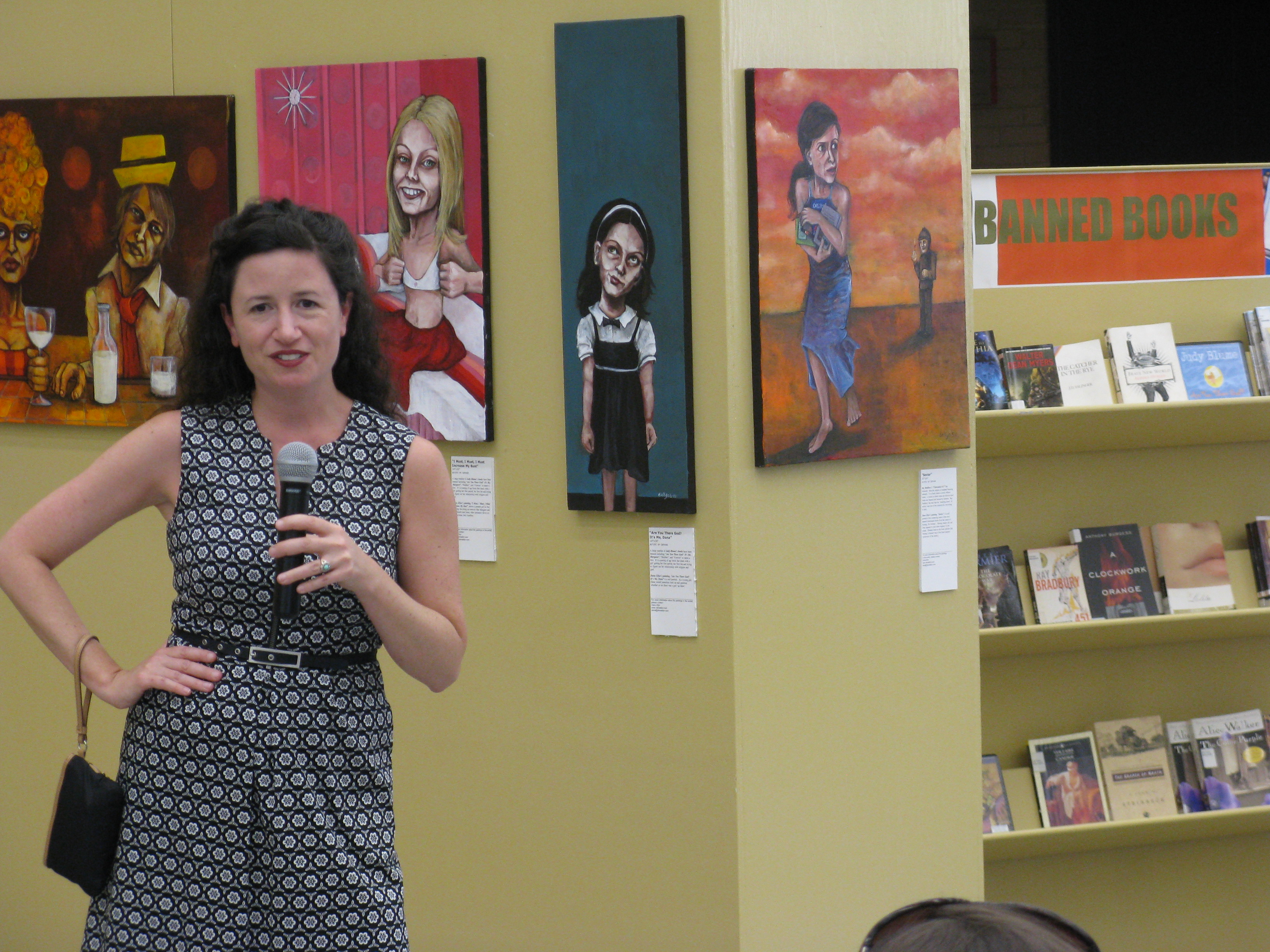
Savior is a self-portrait of Dana Ellyn protecting some of the most banned and challenged books from the match of Montag, the ‘fireman’. Montag stands still, and Dana appears to lack urgency in her escape. Readers learn as the book unfolds that Montag is himself one of the book-keepers, the protectors of the books.
Catch Her! (In the Rye)
16" × 20" · acrylic on canvas
The Catcher in the Rye · J.D. Salinger
The book
J.D. Salinger’s The Catcher in the Rye is perennially banned because Holden Caulfield is said to be an unsuitable role model. Other reasons cited for banning it are excessive vulgar language, sex scenes and questionable moral issues.
The painting
Dana Ellyn’s painting dresses Holden Caulfield in his signature red hunting cap. He looks on as a half-dressed prostitute tauntingly runs past him in a field of rye. He may or may not follow. Holden is in a struggle between ending his teenage years and entering adulthood.
All Animals Are Equal, But Some Are More Equal Than Others
30" × 40" · oil on canvas
Animal Farm · George Orwell
The book
George Orwell’s Animal Farm was completed in 1944 but faced a publishing delay in England. English publishers were afraid of offending their wartime ally, the Soviet Union. The book was banned by Soviet authorities (and in Soviet-controlled regions) for its political content. It draws close parallels to the communist revolution, and one character, a pig named Napoleon, bears a striking resemblance to Stalin.
The painting
The painting’s title is quoted directly from the book. Dana Ellyn has interpreted the quote from her vegetarian point of view: many people treasure their cats and dogs but don’t think twice about eating cows and pigs, or wearing the fur of a rabbit or fox.
The World Said Nothing
18" × 24" · acrylic on canvas
The Chocolate War · Robert Cormier
The book
Complaints against Robert Cormier’s The Chocolate War were primarily about its 200+ swear words and scenes depicting violence and masturbation. It’s the story of a boy in Catholic school who stands up against a cruel mob of bullies and the school system itself.
The painting
Dana Ellyn’s painting was inspired by one scene in the book, where Brother Leon (a teacher) brings a boy in front of the class and accuses him of cheating. When the class fails to defend their fellow student, Leon says, “You turned this classroom into Nazi Germany for a few moments.” The image was inspired by an infamous 1943 photo of a Jewish boy in the Warsaw ghetto being threatened at gunpoint by a Nazi officer.
When You Read This Book, You Read with Mao
30" × 40" · acrylic on canvas
1984 · George Orwell
The book
George Orwell’s 1984 was banned because of its “immoral” topics and “pro-communist” ideas. The challenges against the book were at their highest during the Cold War. Ironically, it was banned in the USSR over claims that it was anti-Soviet.
The painting
Dana Ellyn’s painting was inspired by the famous World War II propaganda poster “When You Ride Alone, You Ride with Hitler”. The poster showed an American businessman driving to work with a white-outlined image of Hitler in the seat next to him. It was meant to encourage car-pooling to conserve gas for the war effort.
Last Tango in Paris
24" × 36" · acrylic on canvas
And Tango Makes Three · Peter Parnell and Justin Richardson
The book
And Tango Makes Three is a children’s book by Peter Parnell and Justin Richardson. It was the most banned book of 2009 and the most challenged book of 2006–2008. It’s based on the true story of two male penguins in the Central Park Zoo who formed a couple and were given an egg to raise, and it’s intended to help teach children about same-sex parent families. Parents of schoolchildren complained that the book makes ‘homosexuality sound normal’.
The painting
Dana Ellyn’s painting is inspired by both this book and the banned film Last Tango in Paris. Combining the two stories, she has created an actual inappropriate relationship between a human woman and a male penguin. They dance among buttercups as a nod to the film’s infamous ‘butter scene’.
The Books
14" × 18" · acrylic on canvas board
Hitchcock’s The Birds
The painting
This painting is not inspired by any particular book. Dana Ellyn has taken the iconic image from Alfred Hitchcock’s The Birds and transformed it into The Books. While researching and reading for the Banned exhibit, she was amazed at how many books are banned and challenged under the guise of protecting children.
Okie Orange Daydream
14" × 18" · acrylic on canvas board
The Grapes of Wrath · John Steinbeck
The book
John Steinbeck’s The Grapes of Wrath appears on the ALA’s list of most challenged books of the 21st century. It was also burned on a number of occasions, including in Kern County, California, the endpoint of the Joad family’s migration in the novel. Critics accused Steinbeck of being a socialist and of championing communist beliefs.
The painting
Dana Ellyn’s painting shows a little girl in the barren yellow landscape of the Dust Bowl. She optimistically waters her orange plant while dreaming of oranges so abundant that they rain down from the sky.
Soma Holiday
22" × 28" · acrylic on canvas
Brave New World · Aldous Huxley
The book
Aldous Huxley’s Brave New World ranks high on the ALA’s list of most banned and challenged books for its themes of sex, drugs and suicide.
The painting
Dana Ellyn’s painting shows a woman under the influence of soma, the drug used to control the World State’s society.
Princess and the Pup (of Terabithia)
16" × 20" · oil on canvas
Bridge to Terabithia · Katherine Paterson
The book
Katherine Paterson’s Bridge to Terabithia is number 28 on the ALA’s list of the top 100 banned and challenged books of 2000–2009. It has been banned for ‘offensive language’ and for ‘promoting satanism, secular humanism and/or new age religion’.
The painting
Dana Ellyn’s painting is in memory of Leslie, the dearly departed queen of Terabithia, and her dog, Prince Terrien.
(Red) Square Dance
20" × 24" · oil on canvas
The Grapes of Wrath · John Steinbeck
The book
John Steinbeck’s The Grapes of Wrath appears on the ALA’s list of most challenged books of the 21st century. It was also burned on a number of occasions, including in Kern County, California, the endpoint of the Joad family’s migration in the novel. Critics accused Steinbeck of being a socialist and of championing communist beliefs.
The painting
The painting stems from the migrants being called “reds”, or communists. The book depicts the deplorable conditions the migrants endured in the camps, but one night there is a square dance that offers a brief respite from the misery. The composition is meant to evoke a communist propaganda poster.
Girl holding an orange
Throughout the book, the Joad family dreams of reaching California, finding fields of orange groves and getting jobs picking fruit.
Pig
“Communist pig.”
Grape vines
Inspired by a passage in chapter 25: “…and in the eyes of the hungry there is a growing wrath. In the souls of the people the grapes of wrath are filling and growing heavy, growing heavy for the vintage.”
Shack
The ramshackle home the Joad family left behind in the Dust Bowl before heading to California with dreams of a beautiful new life.
Buttons
20" × 24" · oil on canvas
The Color Purple · Alice Walker
The book
Alice Walker’s Pulitzer Prize-winning novel The Color Purple has been censored and banned for sexual content, violence and racism.
The painting
Dana Ellyn’s painting was inspired by a moment in the book where Shug helps Celie discover her sexuality, encouraging her to get to know her body and learn how to push her own ‘buttons’. The red and purple color scheme is also symbolic. Shug tells Celie that God does little things for people, like creating the color purple, just to make people happy and give them pleasure in their lives. The flowers on the wallpaper are a reminder to take time to smell the roses.
Little Lolita
10" × 20" · acrylic on canvas board
Lolita · Vladimir Nabokov
The book
Vladimir Nabokov had trouble finding an American publisher for Lolita. It was eventually published in Paris, where it sold out. When Graham Greene named it one of the best books of 1955, a London newspaper editor replied that it was “the filthiest book I have ever read”. British customs seized all copies entering the UK in 1955, and the book was banned in France for two years (1956–1958). The American edition was published without incident in 1958.
The painting
Dana Ellyn’s painting depicts a pint-sized temptress: drinking, smoking and flirtatiously posed.
Devotchka at the Moloko Bar
20" × 24" · acrylic on canvas
A Clockwork Orange · Anthony Burgess
The book
Anthony Burgess’s A Clockwork Orange was banned from schools for objectionable language, and the film adaptation was also banned in several countries for its strong language and excessive violence.
The painting
Dana Ellyn’s painting pulls from several ideas in the book. The title is written in Nadsat, the slang language Burgess created for the novel. In the painting, the protagonist, Alex, sits next to a devotchka (girl) at a moloko (milk) bar.
Alex and his violent gang drink drugged milk to hype themselves up for a night of mayhem. Alex is arrested and put through an experimental aversion therapy program (the Ludovico technique) that turns him into something other than a human being: he loses his power to make choices.
Dana gives Alex the hat worn by Caspar Milquetoast, the 1924 character from the comic strip The Timid Soul. The word milquetoast means a weak and ineffectual person, which is in essence what Alex becomes after his therapy.
Are You There God? It’s Me, Dana
10" × 30" · acrylic on canvas
Are You There God? It’s Me, Margaret · Judy Blume
The book
A large number of Judy Blume’s books have been banned, including Are You There God? It’s Me, Margaret, Blubber and Forever. Are You There God? is a coming-of-age book about a girl getting her first period, her first bra, and trying to figure out her relationship with religion and God.
The painting
This painting is a self-portrait. As a young girl, Dana would sometimes look up and question whether or not there was a god ‘up there’.
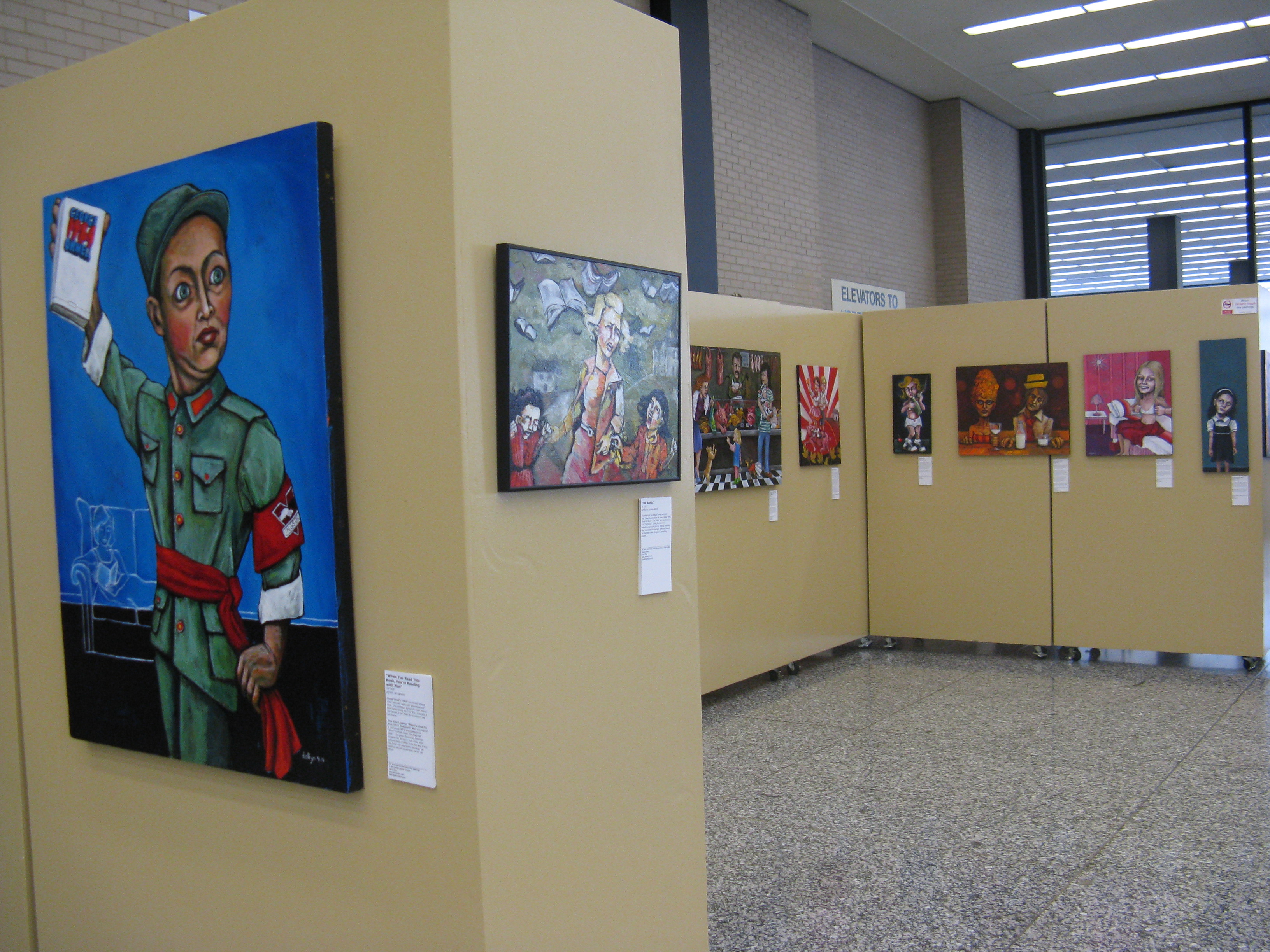
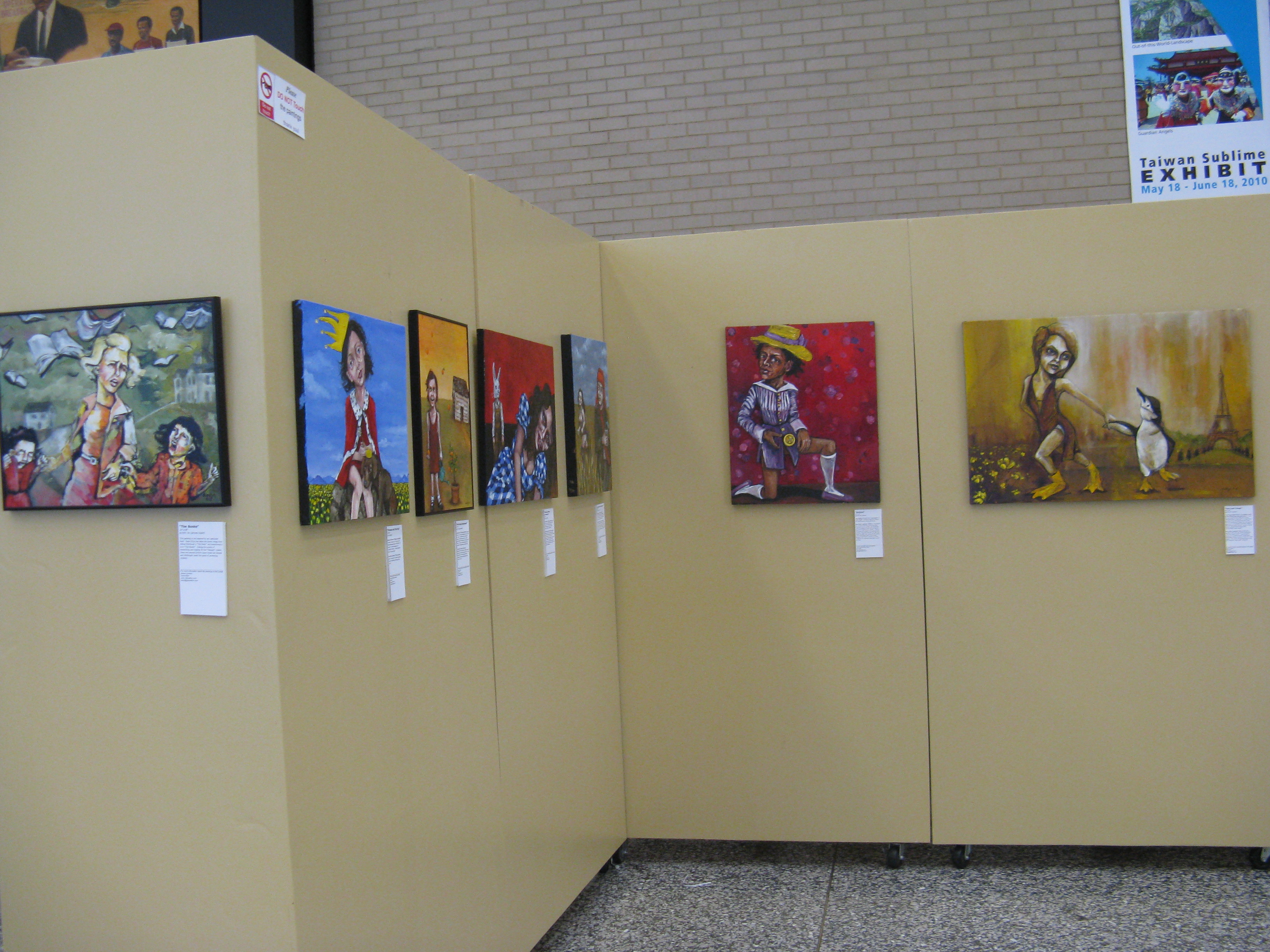
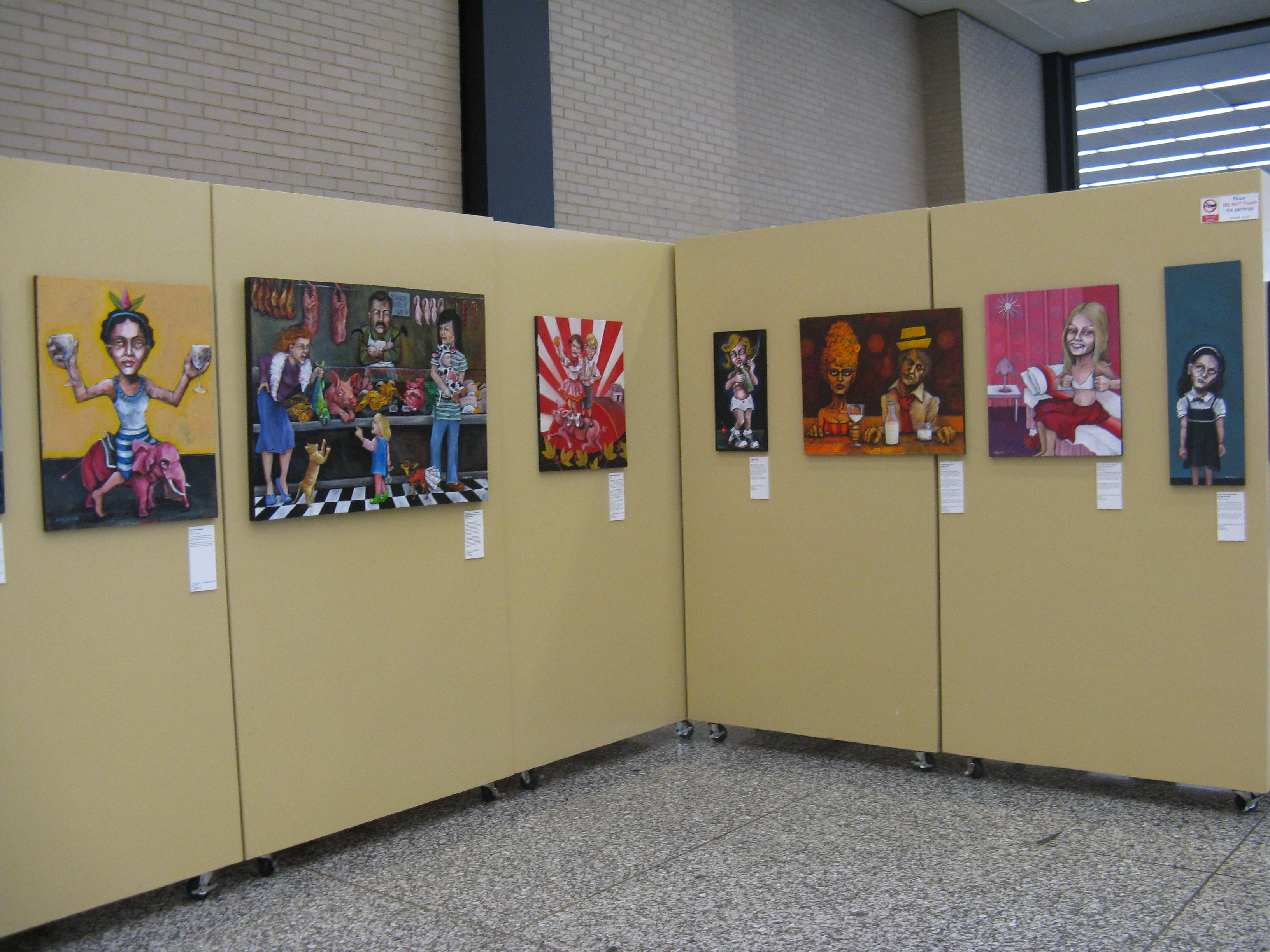
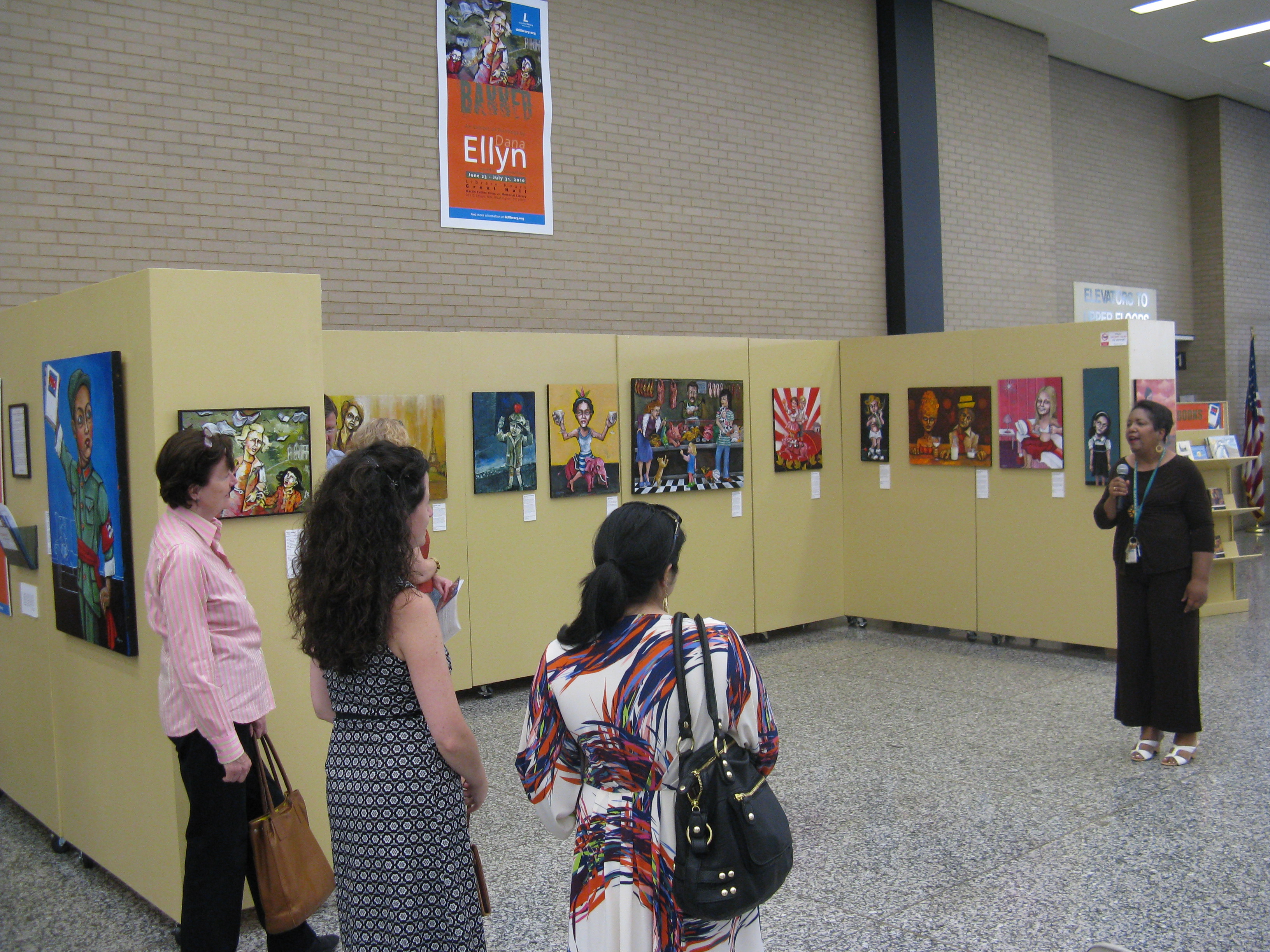
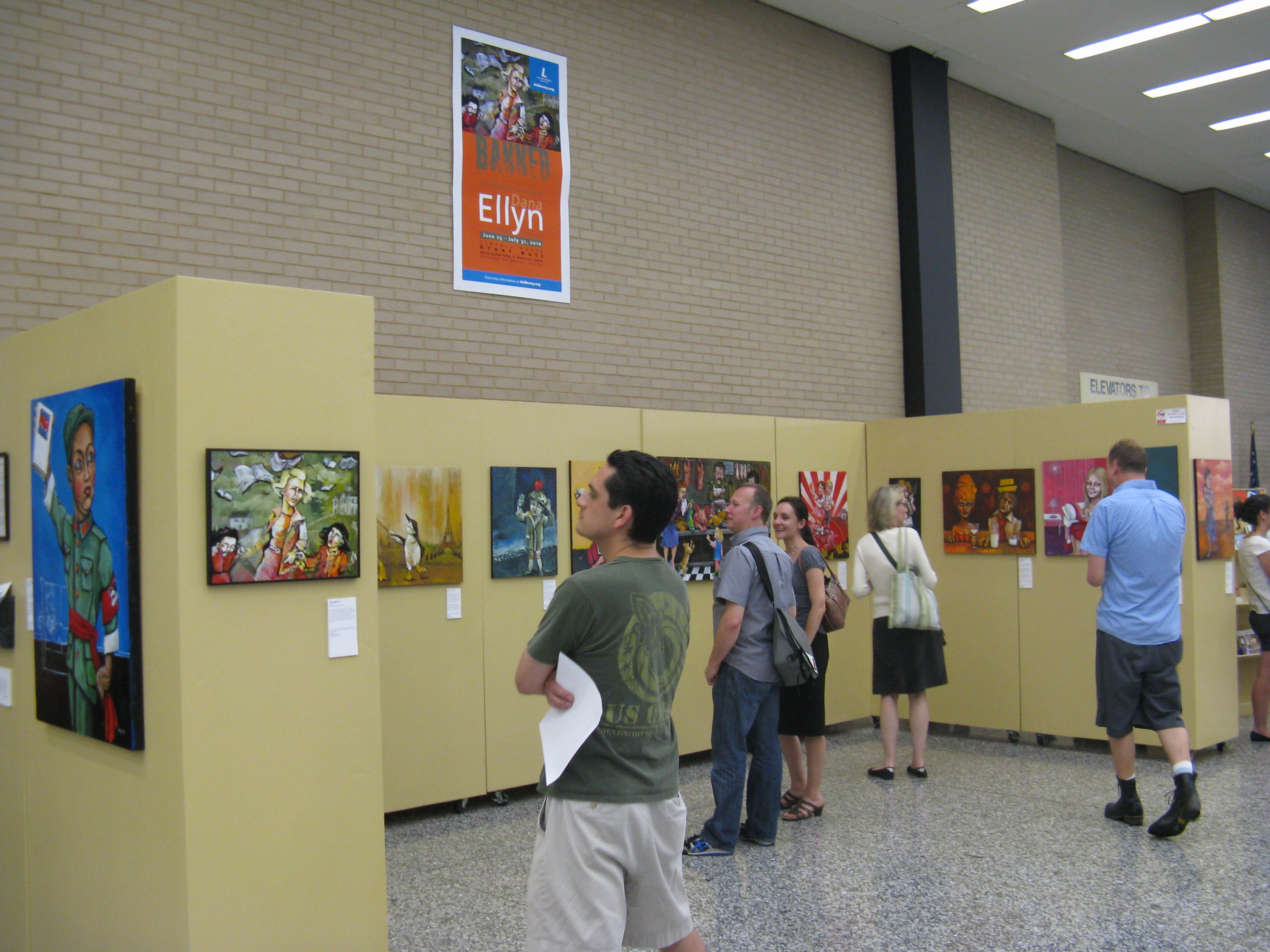
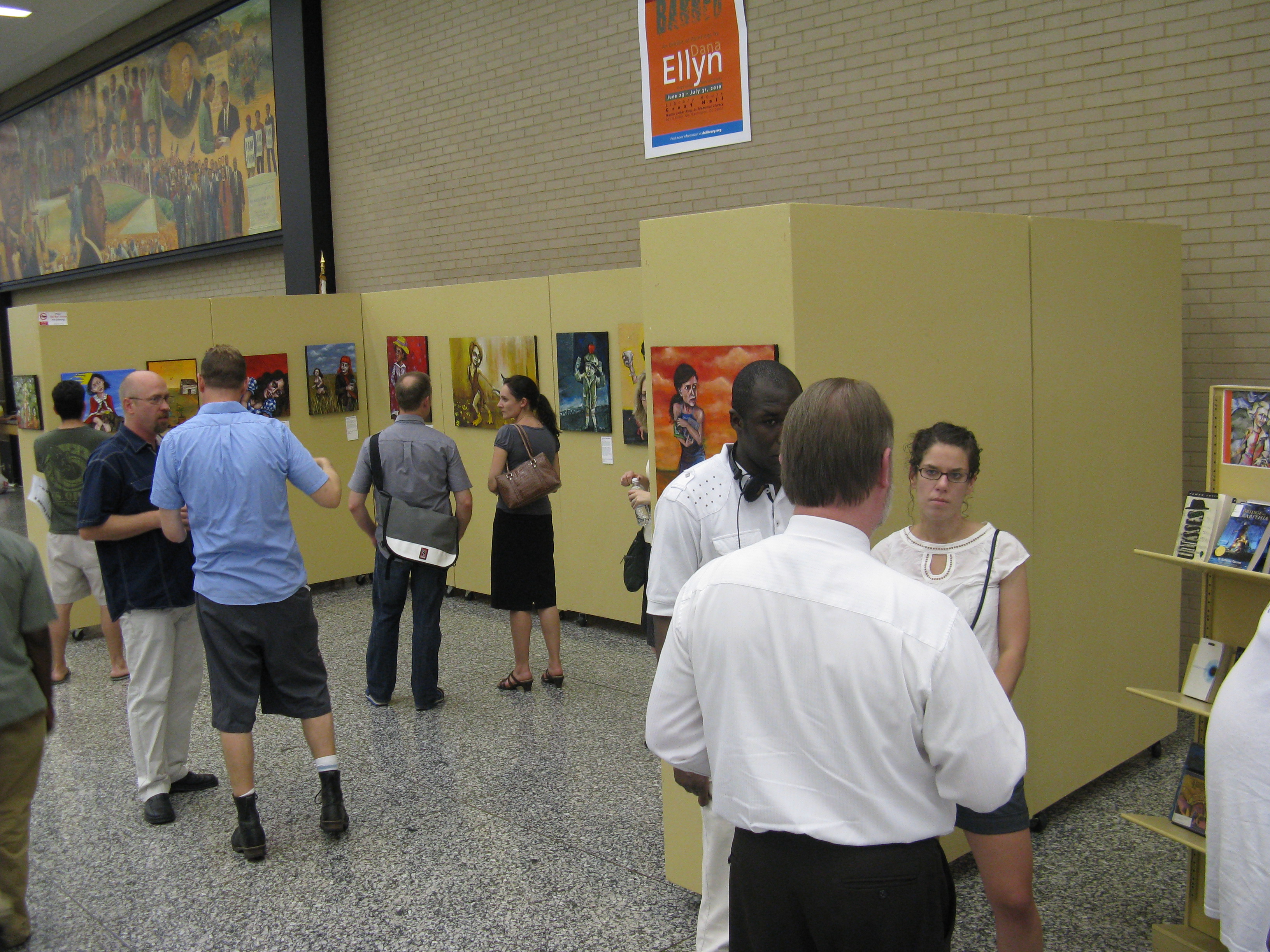
The paintings on freestanding panels in the library’s Great Hall, with Savior at the end of the row and the library’s mural on the far wall.When You Read This Book, You Read with Mao and The Books on the first panel.From The Books (left) to Last Tango in Paris (right).The row ending with I Must, I Must, I Must Increase My Bust and Are You There God? It’s Me, Dana.
Opening reception
Monday, June 28, 2010
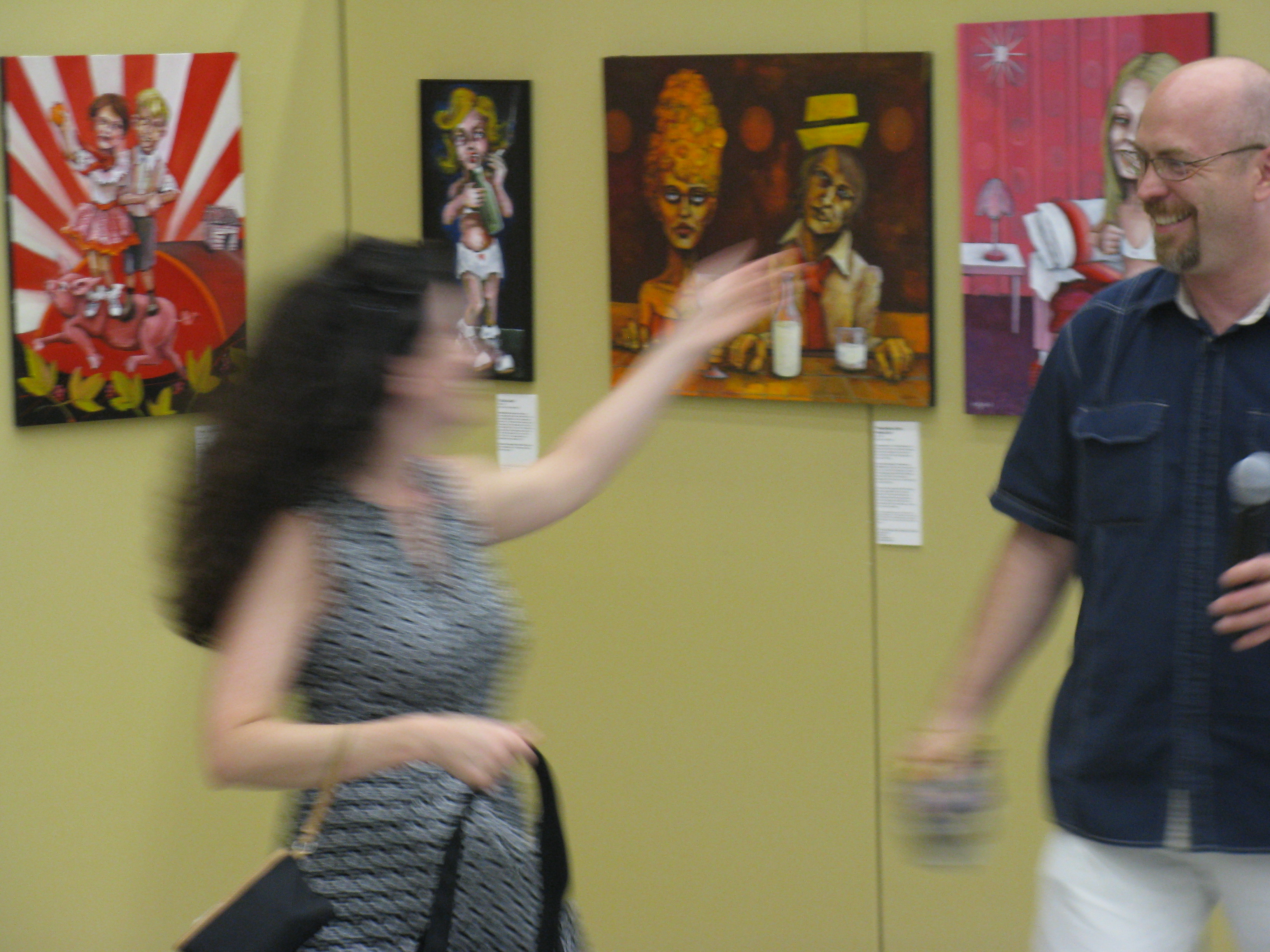
Speaking at the reception, next to the library’s Banned Books shelf.Opening the reception, under the BANNED poster.Guests at the opening reception.The reception, with the library’s mural behind.At the reception.
Interview
10 minutes · Video
A video interview with Dana Ellyn about her paintings in the BANNED exhibit.
In the press
We Love DC · July 1, 2010
We Love DC
We Love Arts: Dana Ellyn, BANNED
By Jenn Larsen · July 1, 2010
“The Books” by Dana Ellyn. Courtesy of the artist.
There was a time when banning a book meant silencing a voice. Flush with the power of our digital age, we may forget that information so readily available to us – both truth and lies – was once so easily stopped. That is, until we read about governmental attempts to control knowledge through digital means and realize it’s all still very prevalent.
I distinctly remember being very frightened as a child by the idea of books being banned – or worse, burned. The clandestine copy of Forever passed around my grammar school, eagerly highlighted, was the best instructor of sex education we had (we have it so easy now, seriously) and when it was confiscated by a puritanical teacher the sense of shame and then rebellion that resulted was a defining moment. Later on, books like Brave New World and A Clockwork Orange spoke deeply to my developing beliefs about personal freedom and responsibility. There’s a natural outrage in me against those who would try to censor artists from holding the mirror up to our not-so civil society.
Artist Dana Ellyn continues her examination of controversial subjects with Banned, a solo exhibit showing now through July 31 at MLK Library. Last December she applied her laser eye for hypocrisy to a wide range of untouchable subjects such as religion, politics, and feminine identity in Divinely Irreverent, a show I unabashedly loved as “an audacious exhibit delivering hard slaps to myths of many kinds.” Here, the examination comes from books banned or otherwise considered subversive – perfect for Dana’s love of metaphor – and the slaps are delivered to those who would ban information and keep us in the dark.
The exhibit opened to coincide with the American Library Association’s annual conference, and it’s worth taking a look at their list of the frequently challenged books – you may be surprised by what you see. Banned features seventeen paintings inspired by controversial books; here are three that I found resonated particularly with me.
“I Must, I Must, I Must Increase My Bust” by Dana Ellyn. Courtesy of the artist.
Along with Judy Blume’s Forever, the other book eagerly devoured by girls of my generation was her classic Are You There God, It’s Me, Margaret. Though the book’s major theme is the main character’s quest for determining what her religion will be or should be, that’s not what I remember most. It’s the chant Dana portrays in her painting I Must, I Must, I Must Increase My Bust. Girls would scream it down school hallways after reading the book, like rabid cheerleaders. The quest for knowledge about what femininity means as your body is changing without your control or consent, perhaps even betraying some, is a rite of passage that still resonates when I look at this painting. Its painfully cheerful pinkness, the stretched smile, the sad little training bra contrasting with her determined fists. Oh, the humiliation!
“Last Tango in Paris” by Dana Ellyn. Courtesy of the artist.
Dana combines two banned works, a book and a film, in the piece Last Tango in Paris. I wasn’t familiar with the children’s book And Tango Makes Three but Dana explained it was based on the true story of two Central Park Zoo penguins who formed a couple and raised a chick from an egg together. ALA notes it as the most challenged book of 2006-2008 and the most banned of 2009. Written by Peter Parnell and Justin Richardson, illustrated by Henry Cole, the authors’ stated purpose is to help parents explain same-sex parent families by using a natural event. One of the most striking aspects of information control is the attempt to stifle facts under the guise of protection, from citizenry to children. To combine this book with the most sexually controversial film of its day is wickedly audacious of Dana, which is why I love her work. The whole painting has a rather uncomfortable soft-core 1970’s porn feel. Does the penguin want to go with this scantily clad vixen? He seems rather confused and hesitant to me, that foot raised in the opposite direction. She may be wearing penguin flippers but I don’t think she’s his cup of tea. And that field of buttercups she’s leading him into… naughty.
“When You Read This Book, You Read With Mao” by Dana Ellyn. Courtesy of the artist.
I always preferred Aldous Huxley’s vision of the future in Brave New World to George Orwell’s 1984. Something about Soma seemed more seductive than the Two Minutes Hate. Then again maybe it was the Malthusian Belt versus the Junior Anti-Sex League. In any case, When You Read This Book, You Read With Mao is Dana’s homage not just to Orwell’s novel itself but a World War II propaganda poster. In the poster, driving alone is equated to driving with Hitler (a recent German AIDS information campaign made the same equation, except with sex, showing that metaphor still has the power to shock). In 1984, the protagonist Winston works in the Ministry of Truth, censoring historical documents to serve the totalitarian desire to control all aspects of life. A painting using the imagery of a propaganda poster to highlight a novel about censorship – now there’s a well-delivered slap. It’s a vivid illustration of Dana’s ability to combine metaphor and meaning. What truly grips me is the sharp color scheme, mimicking the classic book cover, and the iconic stance of the wide-eyed Red Guard. Is he really extorting us to read the book, or ready to throw it on the book-burning pyre?
Free exchange of ideas and knowledge is the gift of being human - it was that desire to trade information that made us evolve and develop our culture. We should be on guard against attempts to silence those voices. Dana’s exhibit is on view in the main room of MLK Library – free for all. It’s a striking meditation on the uncomfortable truths many would prefer stay hidden, or worse, black-lined out of existence, each painting raising many questions. Take a look, and let us know what you think.